Denied Boarding Without a Return Ticket: What Actually Happens
It happens faster than people expect.
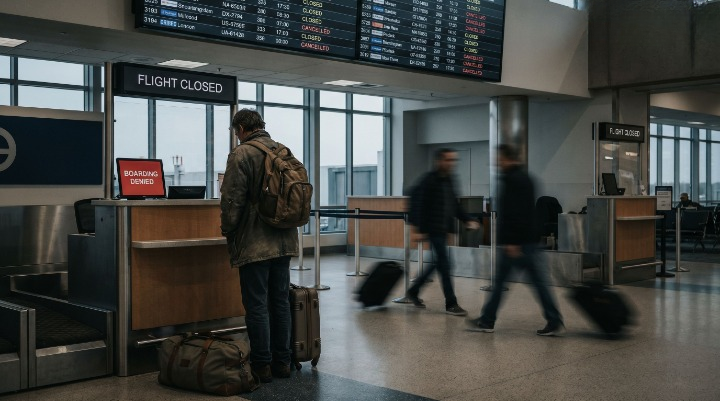
You reach the front of the check-in queue. The agent scans your passport, looks at the screen, and asks the question. You don't have what they're asking for. They explain that without proof of a return or onward flight, they can't issue your boarding pass. The conversation is polite, brief, and final. Behind you, the line moves forward. Your flight closes in ninety minutes.
This is what denied boarding for a missing return ticket actually looks like. Not an argument. Not a manager called over. Usually just a calm statement of policy and a suggestion to sort it out before coming back to the counter.
Understanding why this happens — and what to do when it does, or when you're at risk of it — is the whole point of this article.
Why Airlines Can Deny Boarding for This
The legal and financial logic behind this is simple, even if most travelers never think about it.
Under international aviation agreements, if an airline transports a passenger to a country and that passenger is subsequently denied entry by immigration, the airline is obligated to fly that passenger back — at the airline's expense. The carrier bears the cost of the return flight, any holding fees, and sometimes government fines depending on the jurisdiction. For a budget carrier running tight margins on a $90 fare, that liability can amount to several times the ticket price.
Airlines use a system called Timatic — a global database of entry requirements maintained by IATA — to verify documentation requirements before boarding. When a check-in agent pulls up your booking, the system flags destination-specific requirements including whether proof of onward travel is needed. For destinations with known enforcement (the Philippines, Thailand, the UK, Indonesia, and others), the flag is persistent and trained staff know to act on it.
The agent isn't making a judgment call about you personally. They're following a protocol designed to protect the airline from a liability they'd rather not carry.
What "Denied Boarding" Actually Means at the Counter
There's a distinction worth understanding between denied boarding and being bumped from an oversold flight.
When an airline bumps you from an oversold flight, they've taken your seat and are legally required in most jurisdictions to compensate you — vouchers, alternative routing, sometimes cash. That denied boarding comes with rights and a paper trail.
When you're denied boarding because you don't have the required documentation, the legal situation is different. The airline is refusing to carry you because you haven't met the conditions of travel. You are not entitled to compensation. You don't get rebooked automatically. You don't get a hotel if you miss your connection. What happens next is entirely up to you to solve.
In practice, the agent will usually tell you what you'd need to get on the flight — specifically, a confirmed return or onward booking — and may give you a window to produce it if there's time before the gate closes. Some counters will hold your boarding pass process open for fifteen or twenty minutes while you sort it out. Others, particularly at busy departure halls with tight turnarounds, will simply close your file and move on.
The Airports and Airlines Where This Happens Most
Not every airport and not every carrier enforces this with equal consistency. Knowing the landscape helps.
Cebu Pacific is the most reliably reported enforcer among budget carriers on Southeast Asian routes. Its check-in staff at Singapore Changi, Hong Kong International, Sydney, Dubai, and other departure points have been specifically trained on Philippine-bound passengers and one-way tickets. If you're flying Cebu Pacific to Manila or Cebu on a one-way ticket, the probability of being asked approaches certainty rather than possibility. The full picture of how this plays out on Philippine routes is covered in our Philippines return ticket rules guide.
AirAsia enforces this variably across its network, with more consistent application on routes from Kuala Lumpur and Singapore to Thailand, Indonesia, and the Philippines. Routes departing from airports where AirAsia is the dominant carrier tend to have tighter enforcement — staff are more experienced with the policy and more confident applying it.
Scoot, the Singapore Airlines budget subsidiary, has enforced this on Thai and Indonesian routes with enough frequency to generate forum discussion. Travelers on Bangkok and Bali routes report being asked.
Ryanair and easyJet enforce this on specific European routes, particularly for non-EU passport holders flying into UK airports or into Schengen countries on one-way tickets. The UK's post-Brexit immigration framework has made this more common, not less, in recent years.
Legacy carriers — Emirates, Qatar Airways, Singapore Airlines, British Airways — enforce this less consistently at the counter but are not immune. Long-haul carriers have check-in procedures that are generally less aggressive on documentation spot-checks, but agents at some stations, particularly in cities with high visa overstay rates for the destination, have been known to ask.
The geography that consistently generates problems: flights to the Philippines, Thailand, Indonesia, the UK from non-EU points of origin, and any Schengen entry on a one-way ticket from a passport that requires a visa for the destination.
If It's Happening Right Now
If you're reading this from an airport and you're at or near the counter with a one-way ticket and no onward documentation, the window you have is narrow. Here's what actually works.
Step one: establish the time window. Ask the agent directly how long you have before check-in closes. Most airlines close check-in 45 to 60 minutes before departure. Some budget carriers close earlier. That's your actual working time.
Step two: get a verifiable onward reservation immediately. This is the fastest solvable part of the problem. In most cases, this resolves the issue at the counter. As with any travel document, the final decision rests with the airline staff or immigration officer on duty — but a verifiable reservation with a live PNR gives you the strongest possible documentation for that moment. You don't need to buy a real flight. You need a reservation that passes a system check. iReturnTicket.com/order is built for exactly this scenario: the booking process takes under five minutes, and the PDF with your PNR arrives by email.
Step three: return to the counter. Show the agent the confirmation — either the PDF on your phone or a printed copy if there's a nearby printer. The agent will verify the PNR. If the reservation is real and active in the system, you'll get your boarding pass.
Step four: don't argue about whether the requirement is fair. This loses time you don't have. The agent is following policy. The fastest path through is producing the documentation, not disputing the policy. Save that energy for after you've boarded.
What doesn't work under time pressure: calling the airline's customer service line (they'll tell you to go to the counter), asking to speak to a supervisor as a first move (buys yourself time only if you genuinely have a solution incoming), or trying to show a refundable ticket you're in the process of booking (an incomplete booking with no PNR isn't verifiable).
The Scenarios That Catch Travelers Off Guard
The digital nomad who has done this route before. You've flown into Thailand or the Philippines ten times on a one-way ticket and never been asked. The eleventh time, you are. Enforcement is inconsistent by design — it varies by airport, by agent, by shift. Previous success is not a guarantee.
The traveler with a connecting itinerary on separate bookings. You have a one-way flight from London to Dubai and a separate onward booking from Dubai to Manila. The check-in agent in London sees your final destination as Manila and a one-way ticket. They don't automatically see your Dubai-Manila booking — it's on a different reservation. Having your full onward documentation in hand at every check-in point, not just the last one, matters.
The traveler whose return ticket is on a different name or has already been used. Using the first leg of a round-trip ticket and then trying to show the return leg as onward proof for a new inbound journey creates a documentation mismatch. The PNR may query correctly but show a status that flags the agent.
The group traveler whose documentation is on someone else's phone. This is a practical problem that becomes acute under time pressure. Having your own copy — emailed to yourself, downloaded to your own device — is worth doing before you leave for the airport.
The traveler arriving at 5 a.m. with no data connection. Airport Wi-Fi is not guaranteed, mobile data in transit is not guaranteed, and trying to access email or a booking portal in a stressed state with a countdown running is harder than it sounds. Having documentation accessible offline — downloaded as a PDF, not just accessible via a link — is a straightforward precaution.
After It Happens: Practical Considerations
If you've missed your flight because of this, your options depend on your ticket type and the airline's rebooking policy.
For most budget carriers, a missed flight due to documentation problems falls entirely on the passenger — the airline's responsibility ends at the check-in counter. You'll likely need to purchase a new ticket. If you had travel insurance, check whether your policy covers denied boarding due to documentation issues. Some do, some don't, and the definition of "documentation issue" varies by policy.
If you're holding a flexible or refundable ticket, contact the airline immediately after the incident. The window for rebooking without penalty varies, and staying in the departure hall instead of leaving the airport preserves more options.
The one thing worth doing while you're still at the airport, regardless of outcome: get the agent's name or employee number, and ask for a written record of why you were denied. This is useful for insurance claims, for future reference, and as documentation if there's any subsequent dispute.
The Broader Point
Denied boarding for missing return documentation is preventable. The requirement is not new, not obscure, and not going away — if anything, enforcement has tightened on high-scrutiny routes as airlines have refined their Timatic protocols and staff training.
A verifiable onward reservation costs a fraction of what a missed flight costs in rebooking fees, hotel nights, and rearranged plans. More importantly, it resolves the problem in the time window you actually have at the counter — which is the only time window that matters.
For travelers who move through Southeast Asia and other high-enforcement destinations on flexible, one-way itineraries, treating onward documentation as a standard pre-departure checklist item — alongside passport validity and visa status — is the practical adjustment that stops this problem from happening at all.
For the technical detail on why a verifiable PNR passes airline verification when a screenshot doesn't, see how a verifiable flight reservation actually works.
Frequently Asked Questions
Can an airline legally deny boarding if I don't have a return ticket? Yes. Airlines operate under carrier liability rules that make them financially responsible for passengers denied entry at the destination. Refusing to board a passenger who lacks required entry documentation is legally and contractually within their rights under standard conditions of carriage.
Is denied boarding for documentation different from denied boarding on an oversold flight? Yes — significantly. Denied boarding on an oversold flight typically triggers passenger rights protections and compensation obligations. Denied boarding for failing to meet documentation requirements does not. The airline has no obligation to rebook, compensate, or accommodate you.
Which airlines enforce this most strictly? On Southeast Asian routes: Cebu Pacific, AirAsia, and Scoot are the most consistently reported. On European routes: Ryanair and easyJet for UK and Schengen entries. Long-haul carriers enforce this less predictably but are not exempt.
Can I fix this at the airport in time to still board? Often yes, if you have enough time before check-in closes. A verifiable temporary flight reservation with a real PNR can be generated in a few minutes and verified by the agent on the spot. The critical variable is how much time you have before the check-in counter closes.
Does travel insurance cover denied boarding for missing documentation? Some policies include this, some don't. Check your specific policy wording — look for "denied boarding" coverage and whether it excludes documentation-related refusals. If you travel frequently on one-way tickets, this is worth clarifying before you need it.
What's the fastest legitimate solution if I'm at the counter right now? A verifiable temporary flight reservation from a service that issues real PNR bookings in airline reservation systems. The reservation can be generated on your phone, delivered by email, and verified by the agent within minutes. See how verifiable reservations work for the technical detail on why this passes verification when screenshot PDFs don't.
If you're at the airport right now with a one-way ticket and no onward documentation, a verifiable reservation with a real PNR can be in your inbox in under five minutes.